Product solutions
Engineered Fire Protection for Marine and Offshore Assets
Maretek provides fixed fire-protection and firefighting systems for machinery spaces, cargo areas, pump rooms, electrical rooms, accommodation spaces, galleys and exposed decks. System selection is based on the fire hazard, protected space, vessel type, operating profile and applicable marine or offshore requirements.
Carbon Dioxide Systems
High Pressure Carbon Dioxide
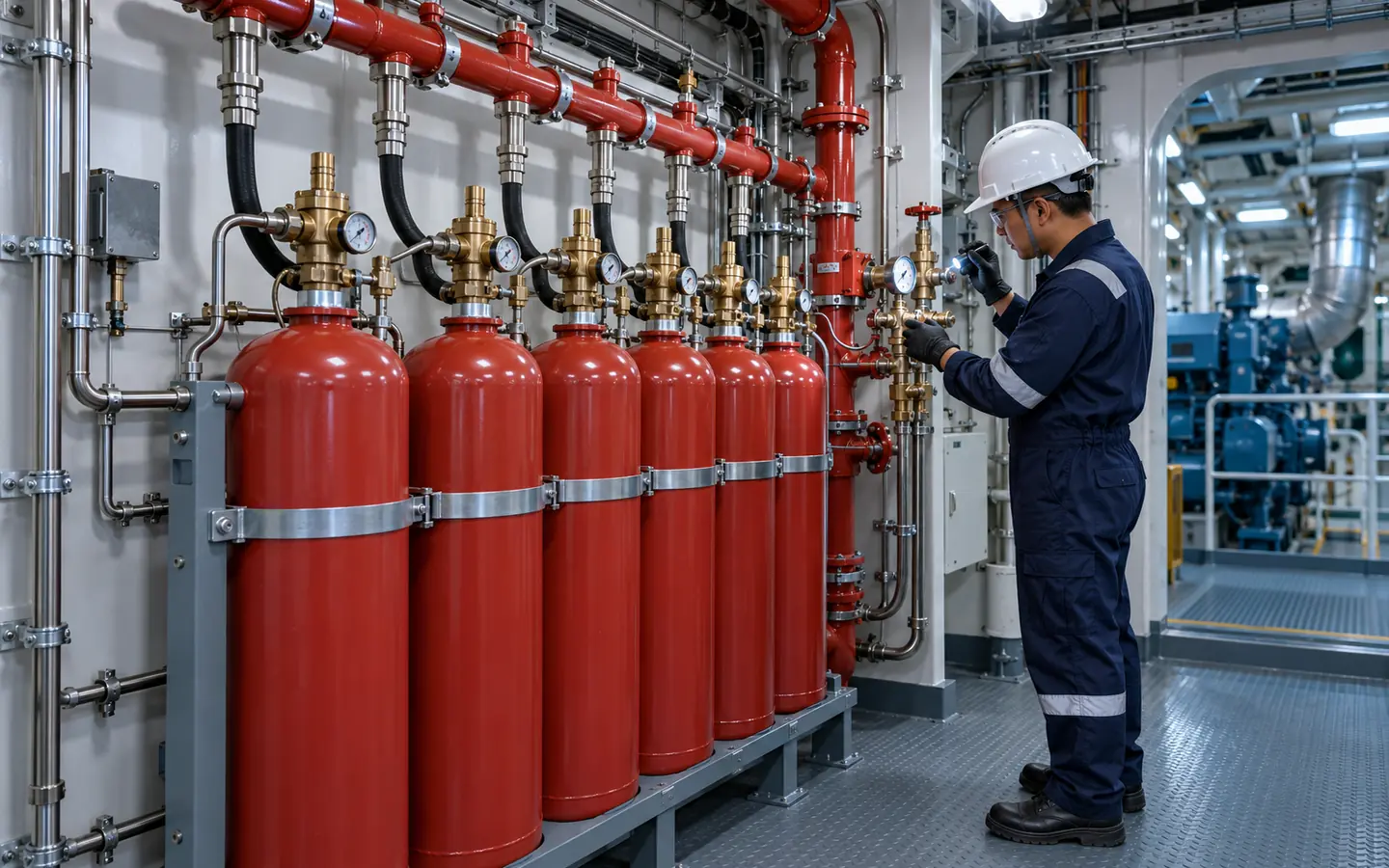
High-pressure carbon-dioxide systems suppress fire by reducing the oxygen concentration within the protected space. They are commonly applied to machinery spaces, pump rooms, electrical rooms, paint stores and cargo holds, and are particularly relevant where the protected hazard is smaller or installation space is limited. Carbon dioxide is stored in pressure cylinders at ambient temperature and discharged through fixed piping and nozzles for total flooding or an approved local application.
Low Pressure Carbon Dioxide
Low-pressure storage is suited to applications that require a larger quantity of carbon dioxide. The agent is maintained in a refrigerated vessel and distributed through fixed piping for total-flooding protection. Such systems may be considered for large cargo or machinery risks on vessel types including Ro-Ro, vehicle carriers, container ships and multipurpose vessels.
Water Based Systems
Water Mist
Water-mist systems discharge fine droplets that absorb heat and contribute to local oxygen displacement as water turns to steam. Compared with conventional sprinkler or spray arrangements, the fine droplet size can support effective suppression with reduced water demand, which is valuable where space, weight and water damage are important considerations.
Water Spray and Deluge
Water-spray and deluge systems provide rapid surface cooling and exposure protection. Marine applications include engine rooms, pump rooms and upper decks of LNG or LPG carriers. Nozzle arrangement, water demand, drainage and the surfaces requiring cooling must be coordinated during design.
Automatic Sprinklers
Automatic sprinklers provide local response during the early development of a fire. Heat at the sprinkler head activates water discharge, while the associated alarm valve and pressure controls initiate the alarm and maintain water supply through the fire pump.
Foam and Dry Chemical Systems
Low and High Expansion Foam
Foam suppresses fire by covering the fuel surface, separating it from oxygen and providing a cooling effect. Low-expansion foam is commonly used for open deck and liquid-fuel hazards, including tanker decks and helidecks. High-expansion foam can rapidly fill enclosed volumes and is produced through coordinated storage, proportioning, piping, generators and controls. Foam type and concentration must be matched to the fuel and application.
Dry Chemical Powder
Dry chemical powder is particularly suited to flammable-gas fires. Systems can combine storage units with hose lines and monitor nozzles to protect loading stations and exposed deck areas on LNG and LPG carriers. Powder may also form part of a twin-agent arrangement on specialised firefighting vessels.
External Firefighting Systems
External FiFi systems equip a vessel to fight fires beyond its own structure. Fire pumps, power transmission, discharge piping and remotely controlled monitors work together to deliver water or foam at the required capacity and reach. A complete design must consider pump location, available power, vessel station-keeping, monitor reaction forces, self-protection deluge and the relevant class notation.
Maretek's source material covers FiFi I, FiFi II and FiFi III arrangements for firefighting vessels, escort tugs, offshore support vessels and other specialised craft. Exact monitor quantity, capacity, throw distance and class criteria must be established from the governing classification rules for each project.
Clean Agent and Inert Gas Systems
FM 200 and Novec 1230
Clean-agent systems are intended for spaces where rapid suppression and reduced residue are important, such as electrical, control and equipment rooms. FM-200 and Novec 1230 are described in the source portfolio as fast-acting agents that interrupt the fire process without the water discharge associated with sprinkler systems. Agent availability, regulatory status and the approved design basis should be verified at the time of quotation.
Aerosol Systems
Condensed aerosol systems use compact self-contained units positioned in or near the protected risk. Their minimal piping requirement can simplify installation where space and weight are constrained. Potential applications include machinery spaces, switchgear and local process hazards, subject to the suitability and approval of the selected system.
Inert Gas Systems
Inert-gas solutions use naturally occurring gases such as nitrogen to reduce the oxygen concentration to a level that suppresses combustion. The technology is intended to protect occupied or valuable spaces without leaving residue, while maintaining clear visibility and avoiding damage to equipment.
Galley Wet Chemical Systems
Marine galleys require focused protection for cooking appliances and fryers. Wet-chemical systems apply a purpose-designed agent to control high-temperature cooking-oil fires and help prevent re-ignition. The source portfolio refers to SOLAS requirements and ISO 15371 type-testing expectations for marine galley applications.
Match the Suppression Method to the Hazard
Provide the protected-space details, hazard type, vessel class and project stage. Maretek can support the selection and engineering of a suitable fire-protection system.
Explore further
More marine solutions.

Talk to Maretek
Let’s define the right solution.
Share your operating environment, system requirements and project stage.